Launch offer — valid today only

📄 Digital book in PDF · read it on your phone or print it

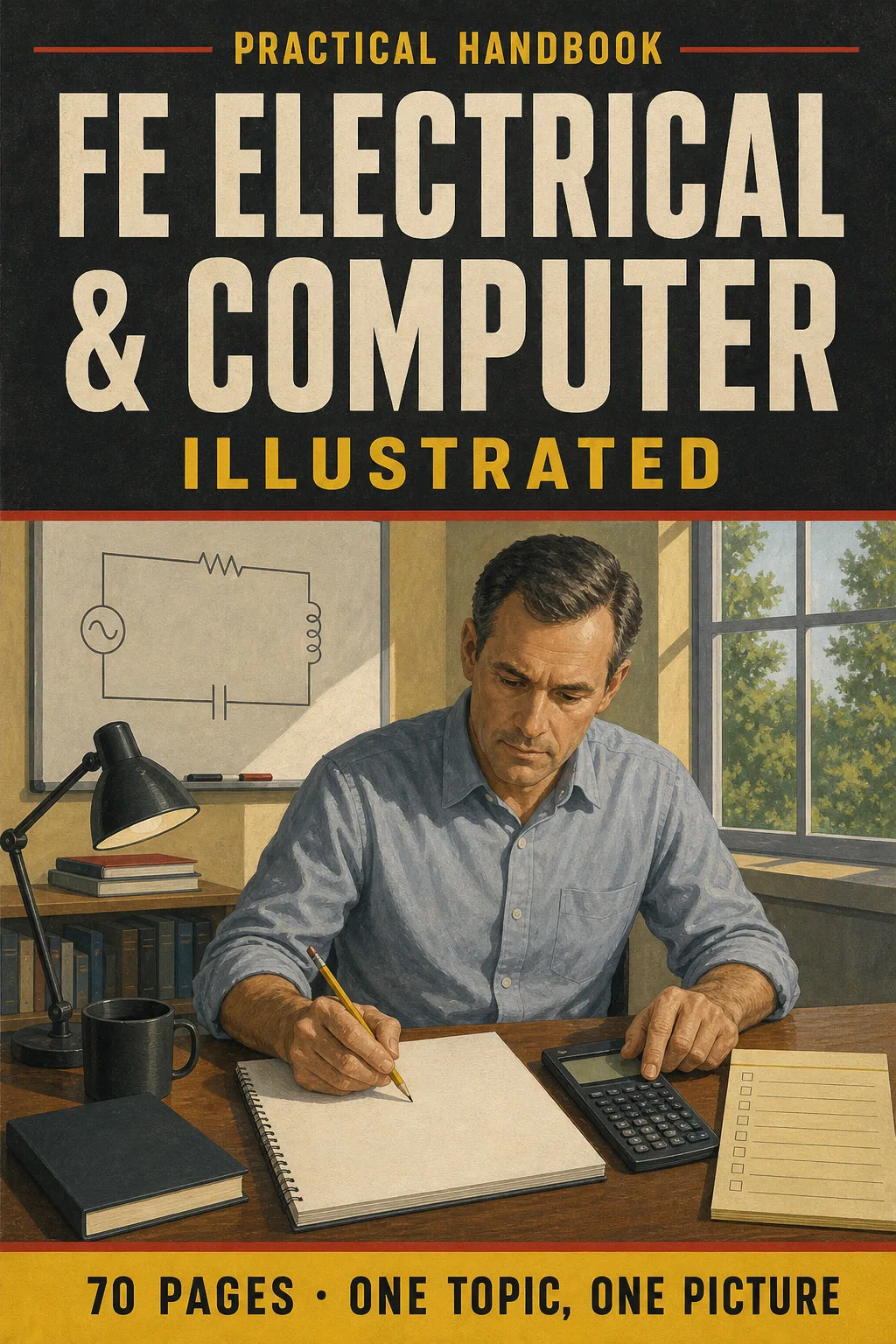
The FE Electrical and Computer Exam in Drawings 66 Exam Topics, Each on Its Own Page

Kirchhoff's laws, nodal analysis, phasors, three-phase power, op-amps, Bode plots, Karnaugh maps and engineering economics. Every topic gets its own page: the drawing first, then what you need to remember. 70 illustrated pages.

START STUDYING THIS WAY

🔒 Secure checkout · PDF by email · 30-day guarantee

Every topic, its own pageEach circuit and formula drawn, with the explanation right beside it
70 illustrated pages9 parts, from the exam format to the final review
Up-to-date sourcesCurrent FE Electrical and Computer exam specifications and FE Reference Handbook
PDF by emailFormat

Look Inside the Book

Every page has one big drawing and a box with the formulas and steps you need to know:

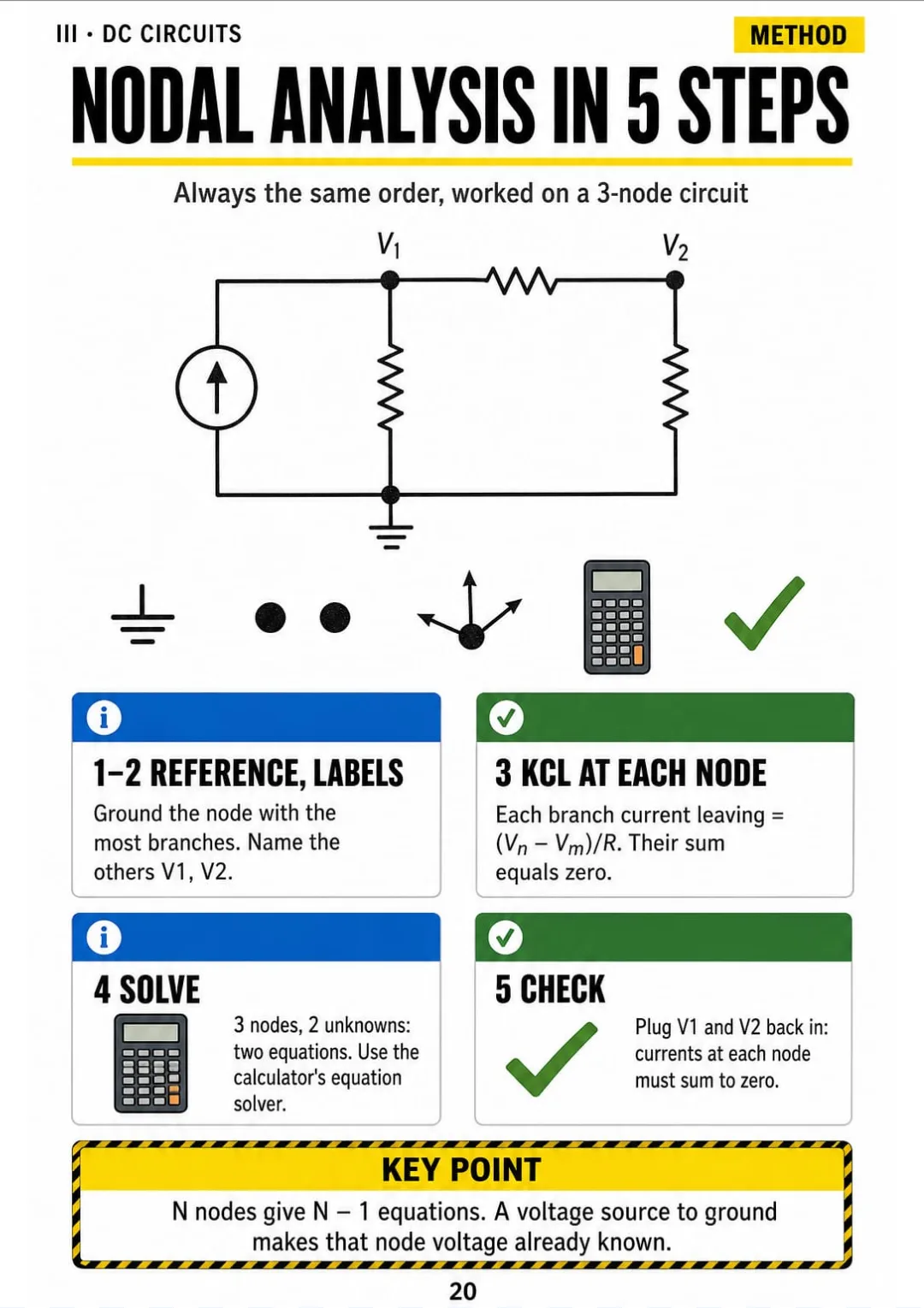
Reference node, label, KCL as (Vn − Vm)/R, solve, check: N − 1 equations
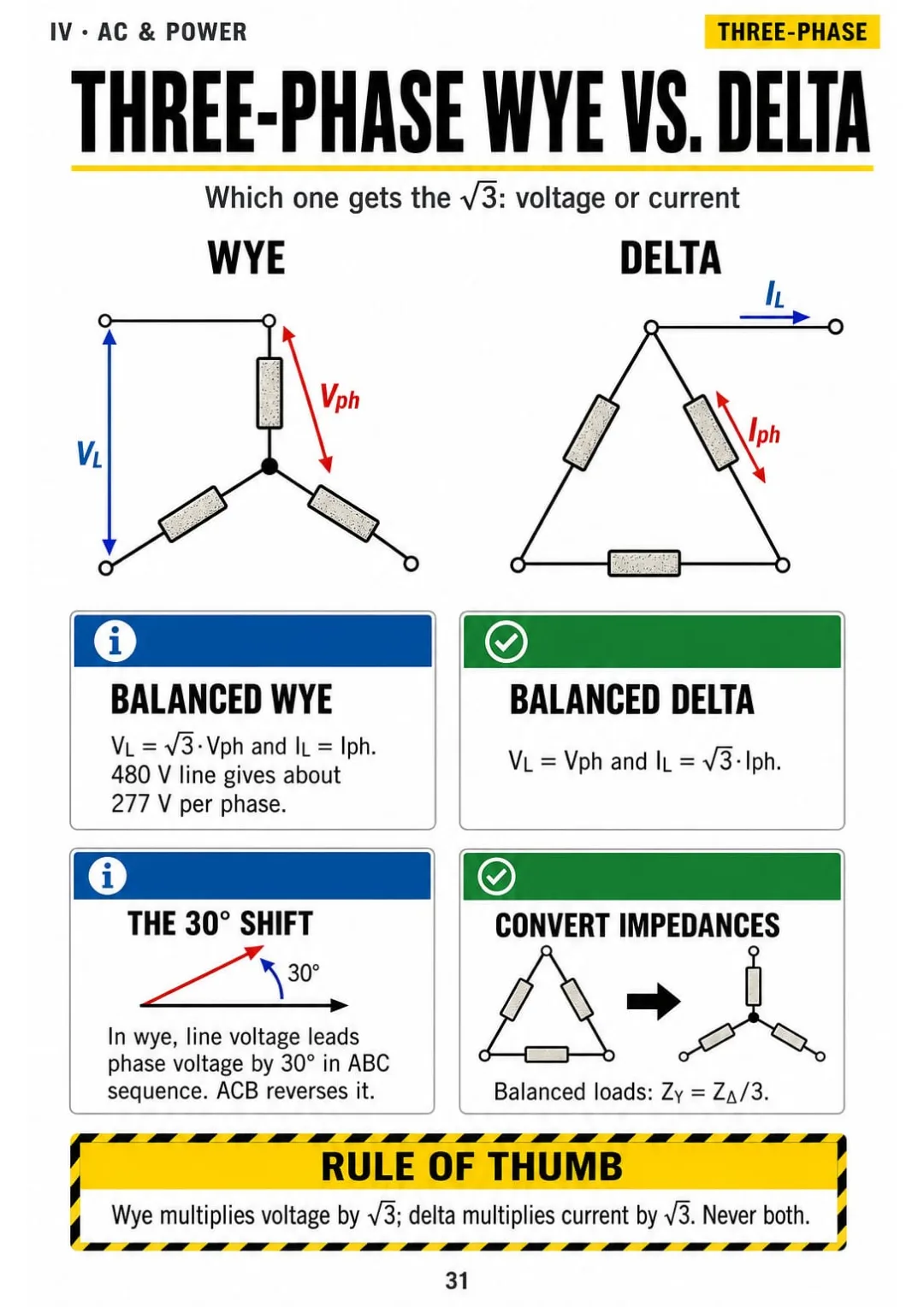
Wye: VL = √3·Vph, IL = Iph · Delta: VL = Vph, IL = √3·Iph · ZY = ZΔ/3
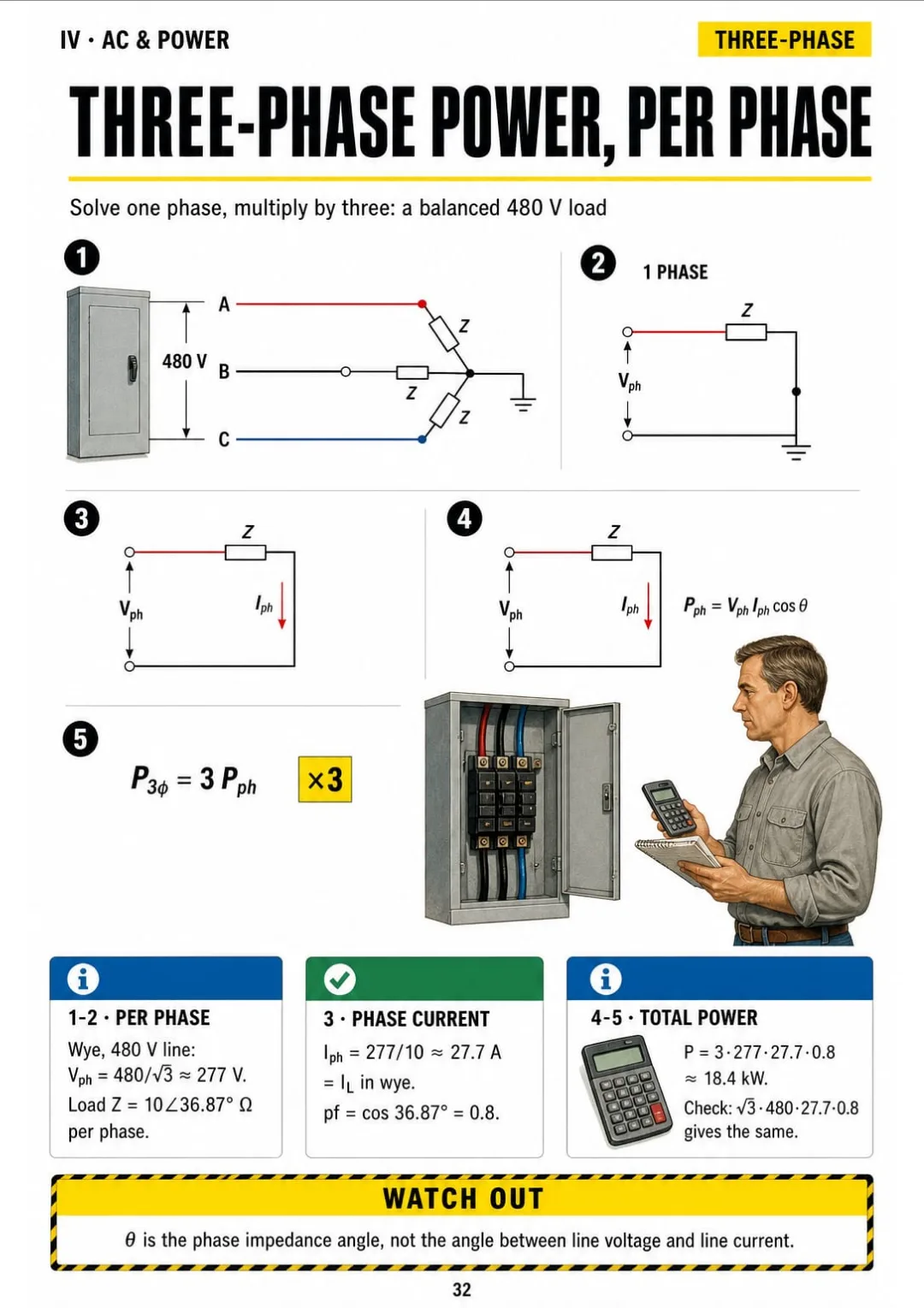
P = √3·VL·IL·cos θ = 3·Vph·Iph·cos θ, solved on a balanced 480 V load
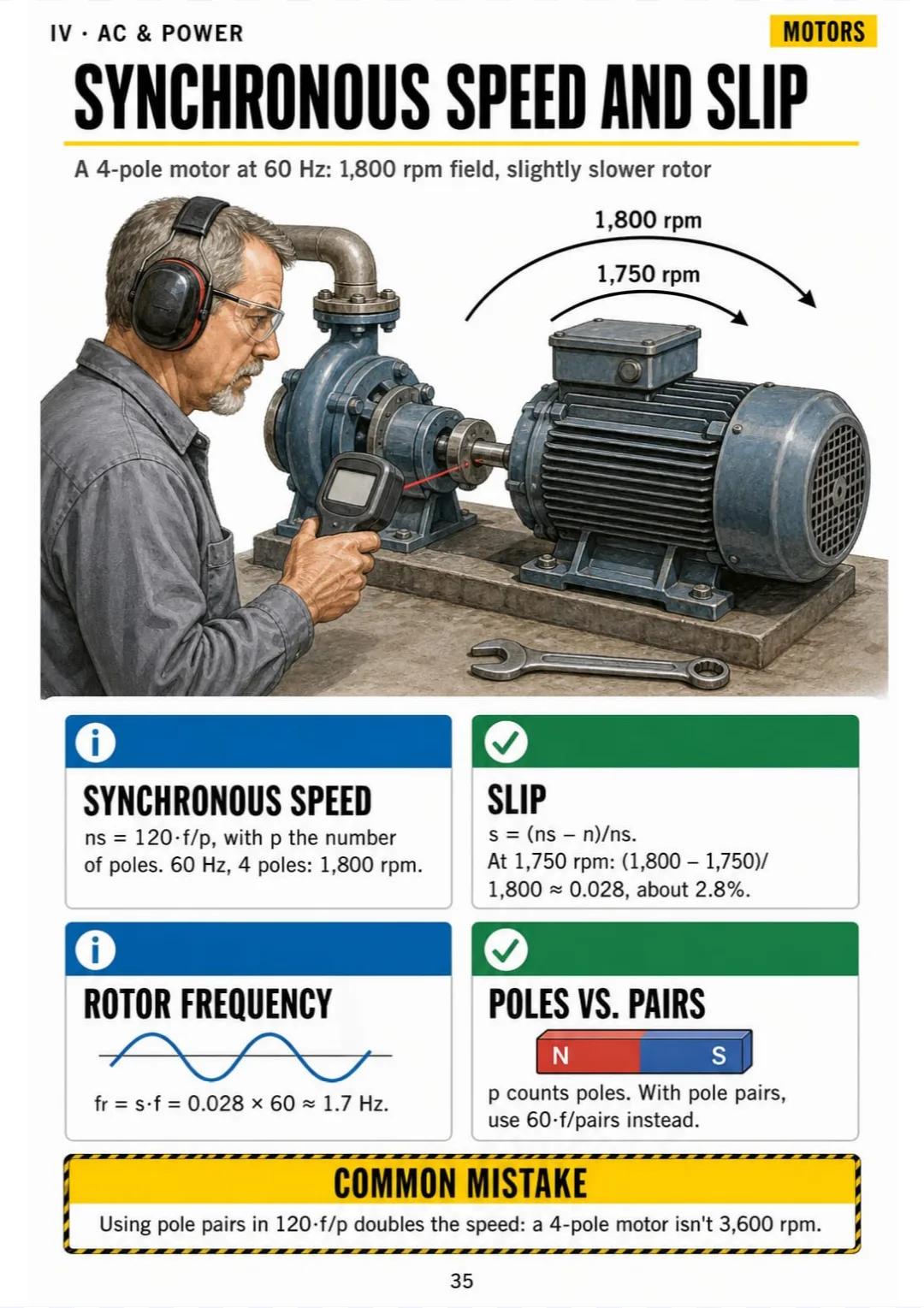
ns = 120f/p: 4 poles at 60 Hz = 1,800 rpm; slip s = (ns − n)/ns
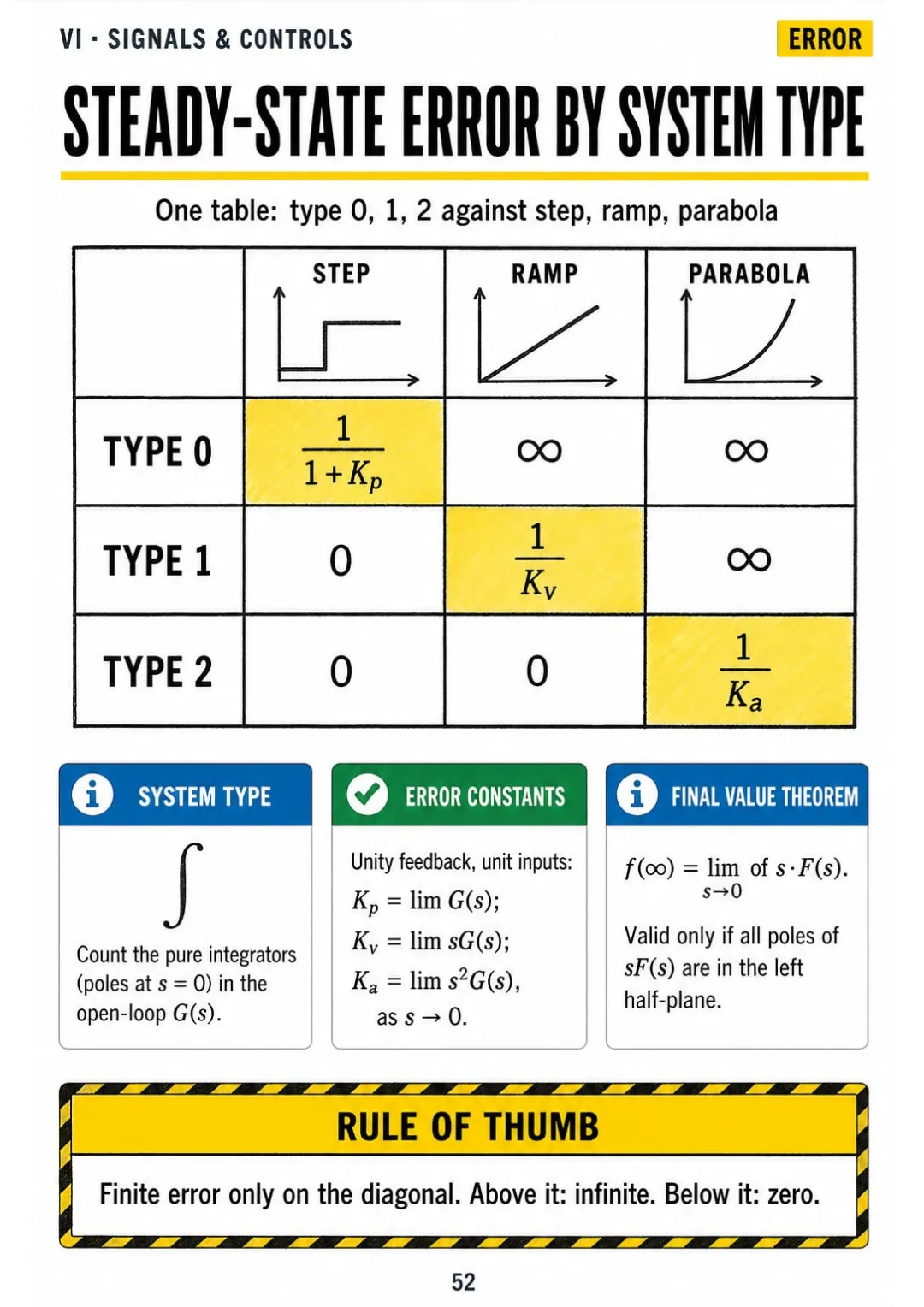
Type 0 step: 1/(1 + Kp); type 1 ramp: 1/Kv; type 2 parabola: 1/Ka
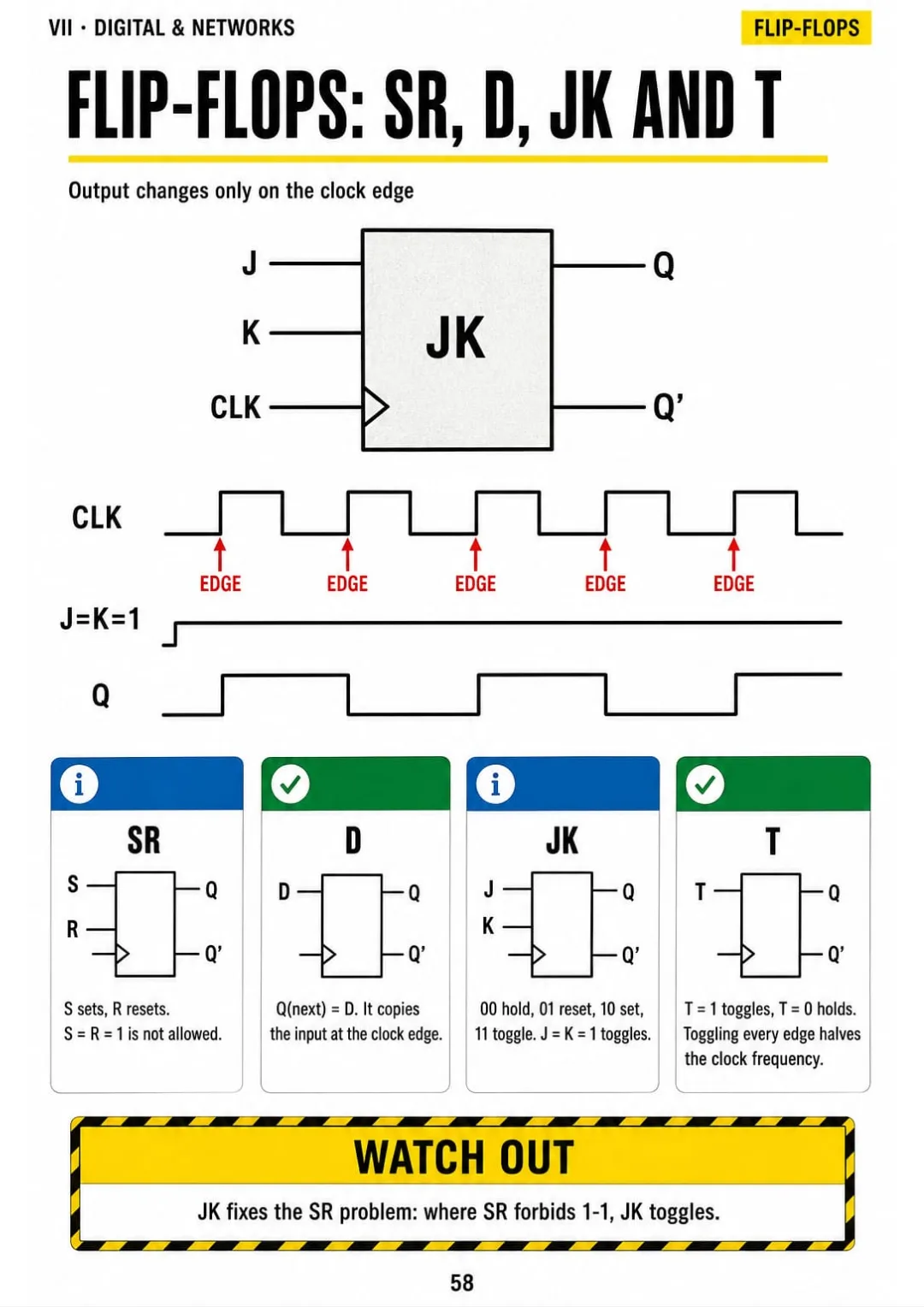
JK with J = K = 1 toggles on every clock edge; SR forbids S = R = 1.
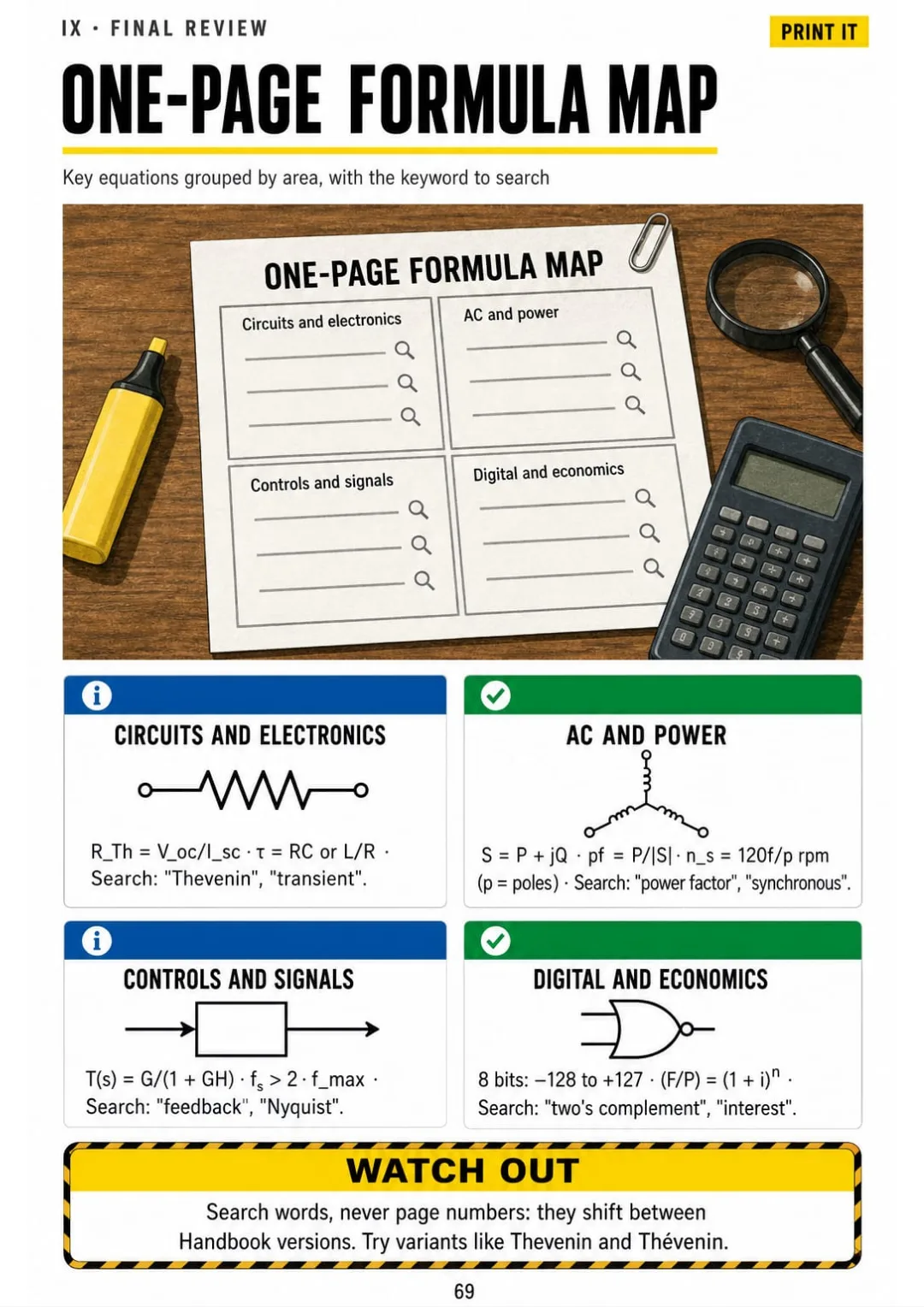
Six areas, one sheet: each formula paired with the Handbook keyword to search
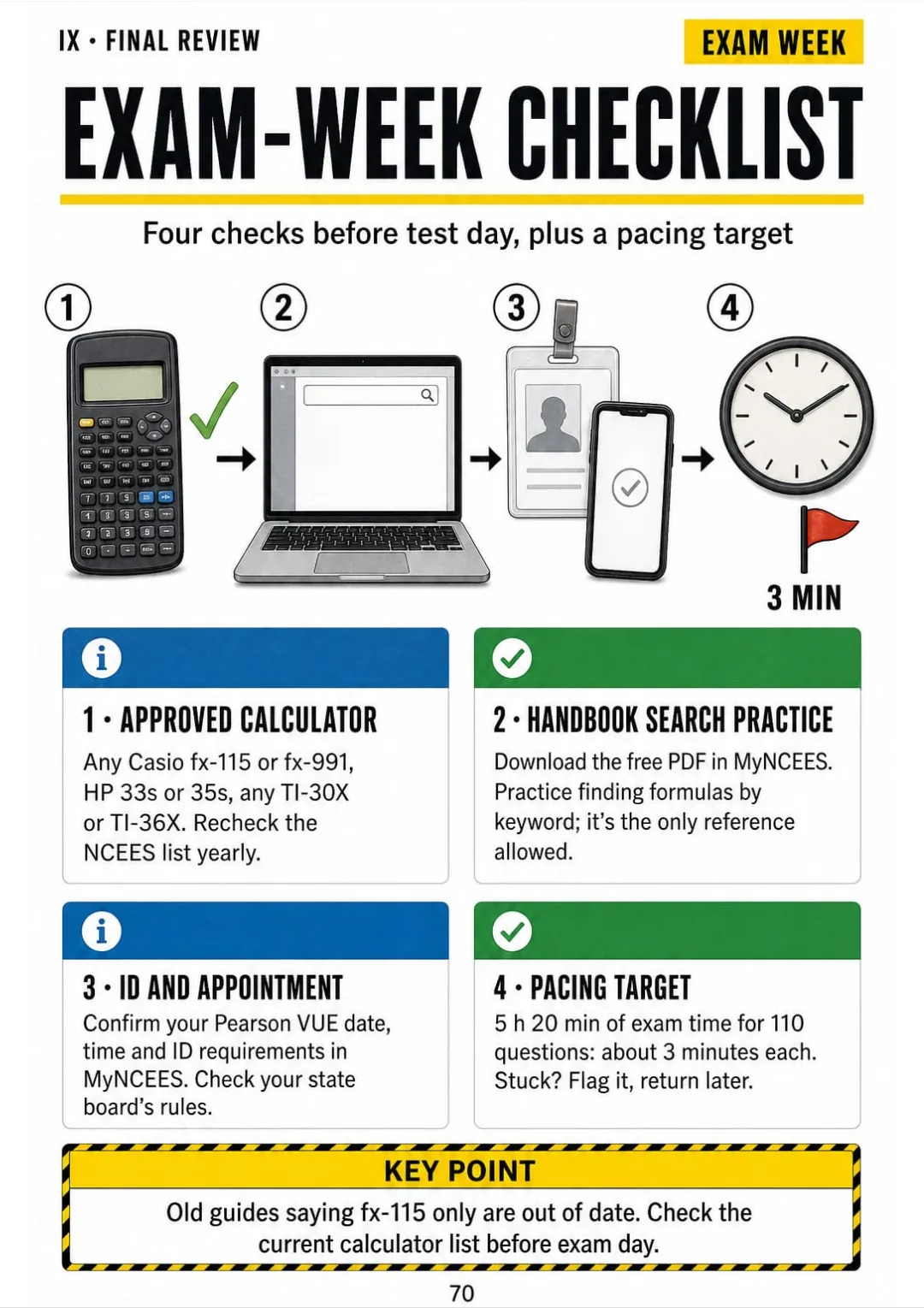
110 questions in 5 h 20 min: about 3 minutes each, flag and return

Swipe to see more →

These are real pages from the book. The table of contents is the full one: 9 parts and 66 topics.

The Problem Isn't You. It's How It Was Explained to You.

It's Sunday night. A practice problem gives you a delta-connected load and a line current, and asks for the phase current. You stare at it and can't remember where the √3 goes.

Your review manual covers wye and delta in four dense pages of derivations. The rule is in there, buried in the algebra, and fifteen years after school it's gone by the next morning.

P = √3·VL·IL·cos θ = 3·Vph·Iph·cos θ, solved on a balanced 480 V load

In this book, wye vs. delta is one page. Two drawings side by side: in wye, VL = √3·Vph and the currents match; in delta, the voltages match and IL = √3·Iph. Below them, ZY = ZΔ/3 sits in its own box.

Nodal analysis, the power triangle, synchronous speed and slip, Bode plots and Karnaugh maps work the same way. Each one has its own page.

You see where the √3 goes, you solve the problem, and you move on without opening the manual again.

COMPARE FOR YOURSELF

Same Topic, Two Ways to Study It

THIS
  • The manual: line after line of text
  • Power factor correction explained only in words
  • You walk into the exam with doubts
Power factor correction refers to the process of improving the ratio between real power and apparent power in an alternating current system by connecting capacitive reactive elements in parallel with inductive loads. Since the reactive power supplied by the capacitor bank must equal the difference between the initial and the desired reactive power, its required rating may be derived from the real power and the tangents of the initial and final power factor angles.
FOR THIS
  • The power triangle in one drawing
  • QC = P(tan θ1 − tan θ2) in a box
  • You see it and you get it
Wye: VL = √3·Vph, IL = Iph · Delta: VL = Vph, IL = √3·Iph · ZY = ZΔ/3
CONTENTS

Take a Look at the 9 Parts and 66 Topics

The exam and the method, the math, DC circuits, AC circuits and power systems, electronics and electromagnetics, signals and controls, digital systems, economics and ethics, and a final review: 70 pages, all illustrated.

IThe Exam and the Method · pp. 5-8
  1. What the FE Electrical and Computer Exam Looks Like
  2. The 5 Steps Used on Every Page
  3. Finding Any Formula in the On-Screen Handbook
  4. SI Prefixes and Units You Convert Without Thinking
IIMath You Use in Every Circuit · pp. 9-15
  1. Complex Numbers: Rectangular vs. Polar
  2. Euler's Formula and Why Phasors Work
  3. First-Order Differential Equations
  4. Laplace Transform Pairs You Actually Need
  5. Matrices and Determinants for Circuit Equations
  6. Probability Basics
  7. Normal Distribution and the Z-Table
IIIDC Circuits · pp. 16-25
  1. Ohm's Law and Power in One Triangle
  2. Series and Parallel Resistors
  3. Voltage and Current Dividers
  4. Kirchhoff's Voltage and Current Laws
  5. Nodal Analysis in 5 Steps
  6. Mesh Analysis in 5 Steps
  7. Thevenin and Norton Equivalents
  8. Superposition
  9. Maximum Power Transfer
  10. RC and RL Transients
IVAC Circuits and Power Systems · pp. 26-36
  1. Sinusoids: Peak, RMS and Average
  2. Phasors and Impedance of R, L and C
  3. Series and Parallel Resonance
  4. The Power Triangle: P, Q and S
  5. Power Factor Correction
  6. Three-Phase Wye vs. Delta
  7. Three-Phase Power
  8. Transformers: Turns Ratio and Referred Impedance
  9. Per-Unit System
  10. Induction Motors: Synchronous Speed and Slip
  11. Synchronous Machines and DC Machines
VElectronics and Electromagnetics · pp. 37-44
  1. Diodes: Ideal, Constant-Drop and Rectifiers
  2. BJT Operating Regions and Biasing
  3. MOSFET Regions and Drain Current
  4. Op-Amps: Inverting and Non-Inverting
  5. Op-Amp Summers, Integrators and Comparators
  6. Electric Fields and Capacitance
  7. Magnetic Circuits and Inductance
  8. Transmission Lines: Reflection and Standing Waves
VISignals, Controls and Communications · pp. 45-53
  1. Sampling and the Nyquist Rate
  2. Fourier Series and Transform at a Glance
  3. Convolution and LTI Systems
  4. Transfer Functions, Poles and Zeros
  5. Bode Plots in 5 Steps
  6. Block Diagrams and Feedback
  7. Second-Order Response: ζ, ωn and Overshoot
  8. Steady-State Error and System Type
  9. AM, FM and Channel Capacity
VIIDigital Systems, Computers and Networks · pp. 54-62
  1. Number Systems and Two's Complement
  2. Boolean Algebra and De Morgan's Laws
  3. Karnaugh Maps
  4. Combinational Blocks: MUX, Decoder, Adder
  5. Flip-Flops: SR, D, JK and T
  6. State Machines: Moore vs. Mealy
  7. Computer Architecture and Memory
  8. Networks: OSI Layers and IP Subnetting
  9. Software: Algorithms and Big-O
VIIIEngineering Economics and Ethics · pp. 63-66
  1. Cash-Flow Diagrams and Interest Factors
  2. Present Worth, Annual Worth and Break-Even
  3. Depreciation and Benefit-Cost Ratio
  4. Ethics and Professional Practice
IXFinal Review · pp. 67-70
  1. RMS vs. Peak and Line vs. Phase
  2. Sign Conventions That Cost Points
  3. One-Page Formula Map
  4. Exam-Week Checklist

One Page, One Topic, All Clear

Think of it this way:

Sunday night, a practice question asks how many kvar it takes to raise a plant's power factor. You need the formula and the steps, not a chapter.

You open the power factor correction page and see the power triangle drawn before and after the capacitor, with QC = P(tan θ1 − tan θ2) in a box and a worked example: 100 kW from 0.75 to 0.95 takes about 55.3 kvar. On exam day, you remember the drawing and you know what to search for in the on-screen handbook.

Type 0 step: 1/(1 + Kp); type 1 ramp: 1/Kv; type 2 parabola: 1/Ka

Thevenin equivalents, wye vs. delta, op-amps, steady-state error and Karnaugh maps work the same way: each one on its own page.

FE Electrical & Computer Illustrated is 9 parts and 66 topics, all drawn, and it ends with a final review: the sign conventions that cost points, a one-page formula map and an exam-week checklist.

What you see drawn, you don't have to memorize.

What's Inside FE Electrical & Computer Illustrated:

Ipp. 5-8

The Exam and the Method

What the exam looks like, the 5 steps used on every page, how to find any formula in the on-screen handbook, SI prefixes and units.

IIpp. 9-15

Math You Use in Every Circuit

Complex numbers in rectangular and polar form, Euler's formula, first-order differential equations, Laplace pairs, matrices, probability and the Z-table.

IIIpp. 16-25

DC Circuits

Ohm's law, series and parallel, dividers, Kirchhoff, nodal and mesh analysis, Thevenin and Norton, superposition, maximum power transfer, RC and RL transients.

IVpp. 26-36

AC Circuits and Power Systems

Peak, RMS and average, phasors and impedance, resonance, the power triangle, power factor correction, wye and delta, three-phase power, transformers, per-unit, motors and machines.

Vpp. 37-44

Electronics and Electromagnetics

Diodes and rectifiers, BJT and MOSFET regions, op-amp circuits, electric fields, capacitance, magnetic circuits and transmission lines.

VIpp. 45-53

Signals, Controls and Communications

Sampling and Nyquist, Fourier, convolution, transfer functions, Bode plots, feedback, second-order response, steady-state error, AM, FM and channel capacity.

VIIpp. 54-62

Digital Systems, Computers and Networks

Number systems and two's complement, Boolean algebra, Karnaugh maps, MUX and adders, flip-flops, state machines, architecture, networks and Big-O.

VIIIpp. 63-66

Engineering Economics and Ethics

Cash-flow diagrams, interest factors, present and annual worth, break-even, depreciation, benefit-cost ratio, ethics and professional practice.

IXpp. 67-70

Final Review

RMS vs. peak and line vs. phase, the sign conventions that cost points, a one-page formula map and an exam-week checklist.

At the end of the book: A final review with RMS vs. peak, line vs. phase, sign conventions, a one-page formula map and an exam-week checklist.
Plus: 2 Free Books

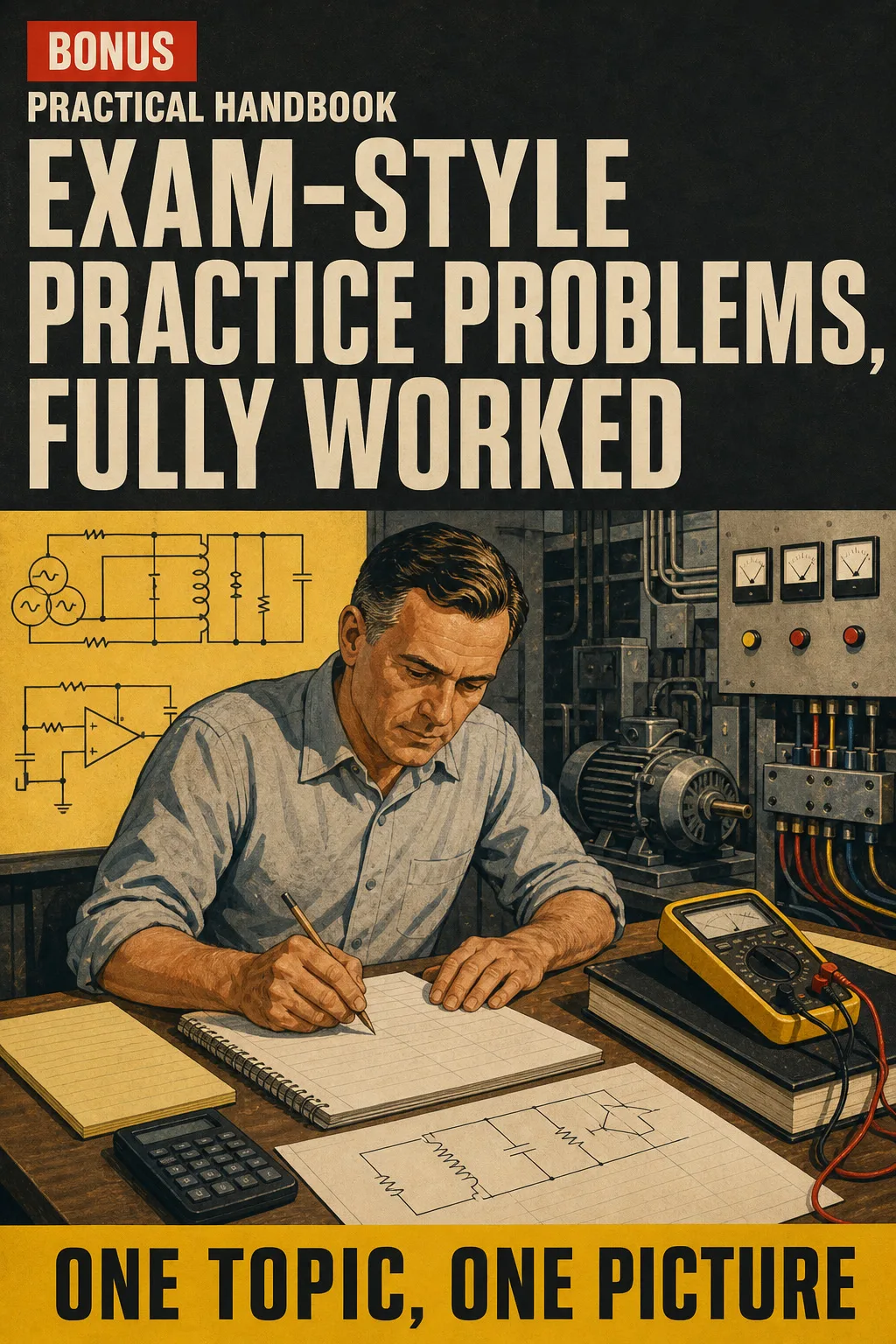
Exam-Style Practice Problems, Fully Worked

BONUS 1: «Exam-Style Practice Problems, Fully Worked»

Value on its own: US$ 17.90

Practice every topic with exam-style questions and see each answer solved step by step, so you know where you went wrong.

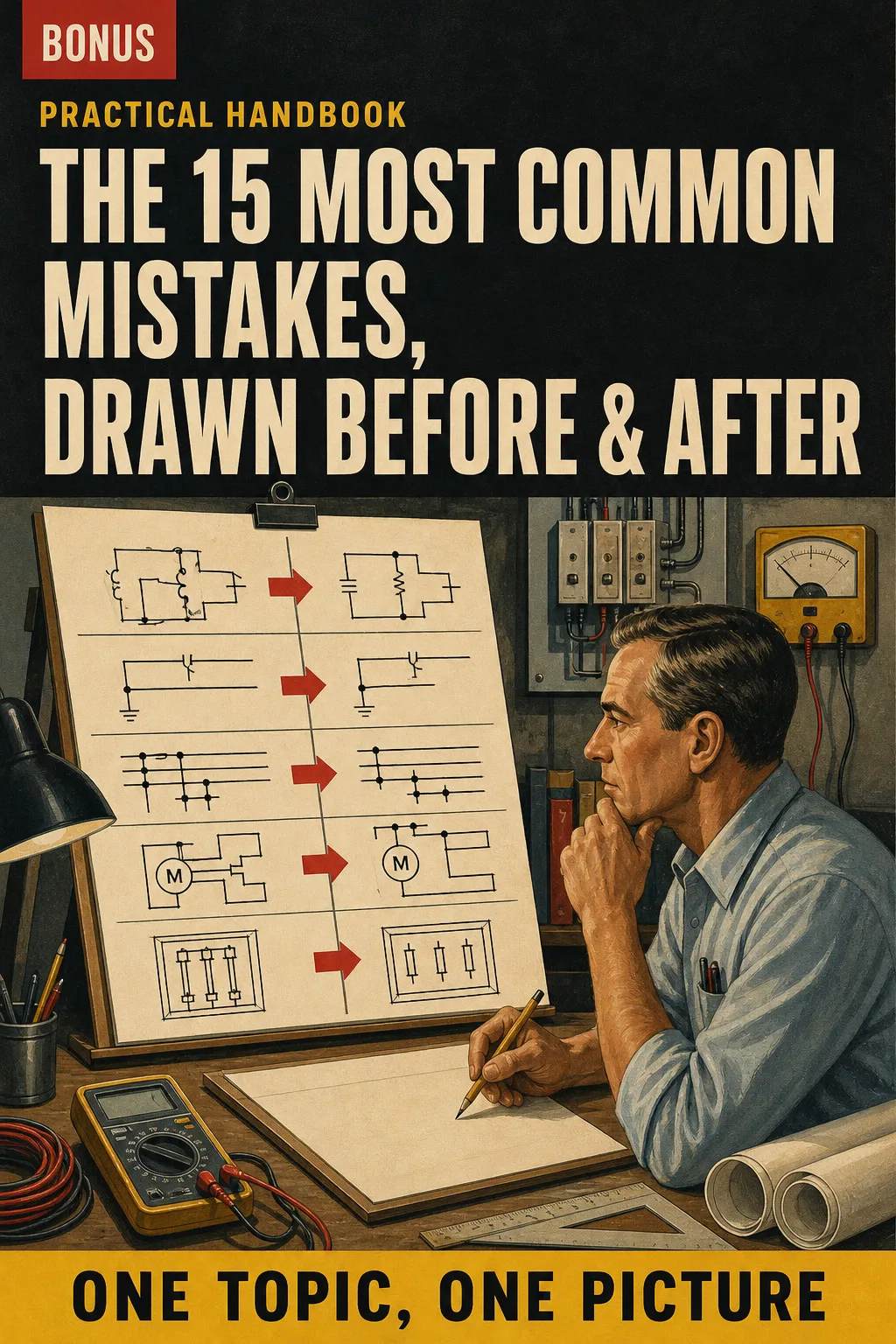
The 15 Most Common Mistakes, Drawn Before & After

BONUS 2: «The 15 Most Common Mistakes, Drawn Before & After»

Value on its own: US$ 14.90

Spot the mistakes that cost points most often (sign conventions, RMS vs. peak, line vs. phase values) and see the right way next to the wrong one.

FE Electrical & Computer Illustrated with 2 Free Books

  • FE Electrical & Computer Illustrated: 70 illustrated pagesUS$ 87
  • BONUS 1: Exam-Style Practice Problems, Fully WorkedUS$ 17.90
  • BONUS 2: The 15 Most Common Mistakes, Drawn Before & AfterUS$ 14.90
  • High-resolution PDF to printIncluded
Total value US$ 119.80
YOUR PRICE:
US$ 37
You save US$ 82.80
YES, I WANT FE ELECTRICAL & COMPUTER ILLUSTRATED FOR US$ 37

📄 This is a digital PDF book sent to your email: nothing is printed or shipped.

Secure purchaseEncrypted payment30-day guarantee

PDF by email: We email you FE Electrical & Computer Illustrated as a PDF, together with the two free books. It's a single payment: no installments, no extra charges.

Who This Book Is For

You're reviewing after years away from school

You're reviewing after years away from school

Every topic starts from the drawing and a worked example in the same 5 steps, so phasors and transforms come back without wading through 900 pages.

Your exam date is booked

Your exam date is booked

You review the whole outline one page at a time and finish with a formula map that pairs each formula with the handbook keyword to search.

You already work in electrical

You already work in electrical

You see the theory behind what you do every day, from three-phase loads to motor slip, drawn and ready to keep on your desk.

Everything You Get Today

US$ 119.80US$ 37
YES, I WANT FE ELECTRICAL & COMPUTER ILLUSTRATED FOR US$ 37

📄 This is a digital PDF book sent to your email: nothing is printed or shipped.

30DAYS
GUARANTEE

30-Day Guarantee

Try FE Electrical & Computer Illustrated for 30 days, bonus books included.

We refund everything if the file won't open, if the book isn't what you see here, if you were charged twice or if the email doesn't arrive. Just email us.

You pay once. No subscriptions.

Frequently Asked Questions

Is this for me if I graduated years ago and never took the FE?

Yes. Each topic starts from the basics with a labeled drawing and a worked example in the same 5 steps, so nothing is taken for granted.

Where does the content come from?

It's checked against the current published FE Electrical and Computer exam specifications and the current FE Reference Handbook. It's written for today's computer-based exam, where the on-screen handbook is the only reference you get, so every formula in the book comes with the keyword to search for it.

Is this official material?

No. It's independent study material, not affiliated with or endorsed by NCEES.

Does it replace a prep course?

No. It's a visual review to study alongside your course, your notes and the reference handbook.

Are the practice questions from the real exam?

No. They're original exam-style questions written for this book, with every answer worked out step by step. On top of that, every topic page in the main book has its own worked example with real numbers, so it's not just theory with drawings.

When and how do I get it?

The book and the 2 bonus books arrive as PDFs by email, at the address you enter at checkout.

Do I have to pay every month?

No. It's a one-time payment.

Can I have it on paper?

Yes. The PDF is printable, so you can print the whole book or just the pages you want to keep at hand.

How does the refund work?

You have 30 days. We refund everything if the file won't open, if the book isn't what you see on this page, if you were charged twice or if the email doesn't arrive: just email us.

Before You Close This Page

No more rereading without anything sticking.

Wye vs. delta: you see it drawn and you've got it.

You walk into the exam knowing where everything is.

Drawings make studying faster.

The book is right below.

One-time payment: US$ 37 · Guarantee: 30 days · PDF by email

YES, I WANT FE ELECTRICAL & COMPUTER ILLUSTRATED FOR US$ 37

📄 This is a digital PDF book sent to your email: nothing is printed or shipped.